
General Information
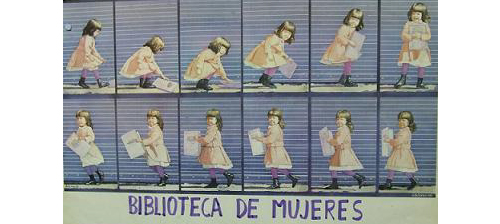
The Women's Library is a specialist library created in 1985 by Marisa Mediavilla Herreros, feminist, librarian and archivist. She was soon joined on the project by Lola Robles Moreno, feminist, philologist and writer, who was to stay with the library almost all her career, as would many other collaborators without whose work the library would never have become what it is today.
In 1991 it became a state-wide non-profit organisation.
She has been a member of the Women's Library and Archive Network since the outset and was also a member of the María Moliner Association..
Objectives
As well as sharing the same objectives as all libraries, the Women's Library was set up to:
- Bring together the culture and knowledge that women have created throughout history, and especially the history of women in Spain.
- Highlight and publicise the contribution of women to society - the untold, silent history..
- Be a meeting place where information and experiences can be exchanged.
- Compile and preserve documents prepared by the Feminist Movement.
Collection
It contains 30,000 volumes, consisting of feminist, feminine and misogynist studies and essays (written by both sexes), biographies, artistic and literary work, as well as grey literature, magazines and special collections including agendas, calendars, posters, pamphlets, stamps, stickers, cards, comics, badges etc.
It contains some work from the 18th century and a considerable amount from the 19th century and the first two thirds of the 20th century. The majority of this material is no longer in print, and was bought at second-hand book shops, the Rastro and Mercat de Sant Antoni markets and at Antiquarian Book Fairs. Some of the documents are impossible to find elsewhere today..
Donations to the Institute of Women
In 2006, the Women's Library Association, which for over two decades had administered and promoted this bibliographic and archive collection, donated it to the Institute of Women, which has been its custodian ever since. The Institute has ensured that it continued to grow, making it available for public consultation and research.
Consultation of the bibliographic archive
Since 8 October 2010 the archive can be consulted via the Institute's bibliografic database.
Library users can also consult the
Association's
catalogue
 for works by Spanish women authors published prior to 1936
(even though these might not be literary works) as well as an up-to-date
catalogue of magazines.
for works by Spanish women authors published prior to 1936
(even though these might not be literary works) as well as an up-to-date
catalogue of magazines.
Services offered by the Women's Library
- Bibliographical information
- Online catalogue access
- Reading room
- Internet access
- Photocopy service
The Women's Library is a testimony to women's struggle in Spain, created as it was at the time of the emergence of the Feminist Movement, and because it is the result of the collaboration of numerous women who have passed through it over these 25 years, with thousands of unpaid hours of work..
The library represents the cultural heritage of women who had been denied one for so long.
Contenidos relacionados
Publicaciones